Client
NOI Techpark (South Tirol, Italy)
Date
August 2022
Services
Stationary PEM fuel cell for extreme weather
Rooftop solar has a timing problem. It peaks at midday and in summer, while a building needs power and heat in the evening and in winter.
NOI Techpark Bruneck, the automotive and sustainable-mobility site of South Tyrol's technology park, set out to close that gap with hydrogen: make it from its own surplus solar, store it on site, and turn it back into power and heat when the sun is gone.
The fuel cell at the end of that chain is a Nedstack.
NOI wanted hydrogen to do more than fuel vehicles. The project was meant to show what hydrogen can do beyond mobility: store a building's own renewable energy, not just for the evening but for the season ahead.
That asks a lot of one system. It has to take irregular solar surplus, hold the energy for months on a campus full of people, and deliver both electricity and usable heat on demand. The Province of South Tyrol backed it with €2.8 million for the hydrogen storage.

Seasonal storage on a public campus. Instead of compressed gas, the hydrogen is bound in metal hydride tanks at low pressure and low temperature, on site.
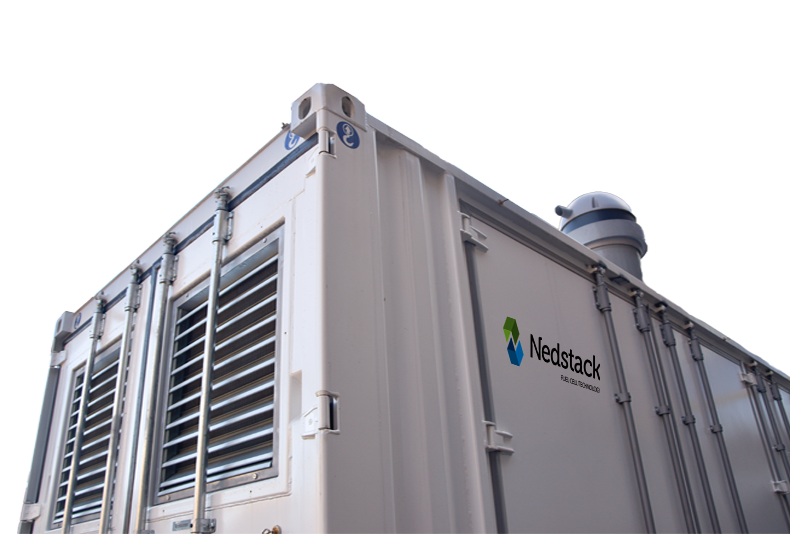
The 120 kW Nedstack system was built as combined heat and power. Alongside electricity, it recovers heat for the building, so the stored hydrogen serves both demands.
The system was designed as an autonomous energy unit. When the grid fails, it can keep critical loads running, such as the ventilation of the underground car park.
NOI Techpark showed that a PEM fuel cell has a place in a building's own energy system, not only in industry or transport. Hydrogen here is the storage medium: made from the roof's surplus, stored on site, used when the sun has gone.
It also closed a loop in Nedstack's track record. Delfzijl ran for 15 years on by-product hydrogen from a chemical plant. Bruneck makes its own hydrogen from the sun, and uses both the power and the heat.
That is still the standard we design to: power that keeps going, even when the sun doesn't.


Contact us today, and your hydrogen project begins.